

Even superhuman AI may not replace jobs
Predictions of human substitution overlook the role of firms


This is a special multi-part edition of Post Haste, exploring AI’s effect on the labour market. Make sure you’re subscribed to read all three instalments. You can read part one here.
By Dr Pedro Serôdio (@pdmsero)
Even if AI surpasses humans at every cognitive task, human labour can still matter, and many jobs (or even new ones) could still exist. Not because humans are special, but because they are different.
Last week, I argued that how AI capabilities evolve matters at least as much as whether they eventually arrive. So what happens if they do arrive? Today I argue that even if AI becomes superhuman, this does not inevitably lead to replacement of human labour.
This is because of how firms are organised. The typical labour-replacement story looks solely at tasks being replaced, rather than the organising role played by firms.
This means that most analyses understate the amount of economic transformation that replacing all human labour would require.
The economics of labour substitution
At current capabilities, AI has not yet displaced entire occupations. It can perform many tasks within a role at or above human level, and some companies may have even reportedly stopped hiring for junior roles. However, it is still inefficient at replacing occupations at scale.
A worker’s job is essentially a bundle of tasks. Where most of these can be automated, the near-term adjustment may be to just repackage the jobs: move harder-to-automate tasks into new roles and get humans to supervise the rest. The question becomes one of relative efficiency: how much better must AI become at some tasks for adoption to be worth it?
We can use a simple model to explore this question. If AI is a perfect substitute for human labour and sufficiently cheap to run, it replaces all human labour, and human labour adds nothing even when combined with AI.
This is shown in the top-left quadrant of the plot below. AI is a perfect substitute for human labour and cheaper at every task, so there is no role for human labour.
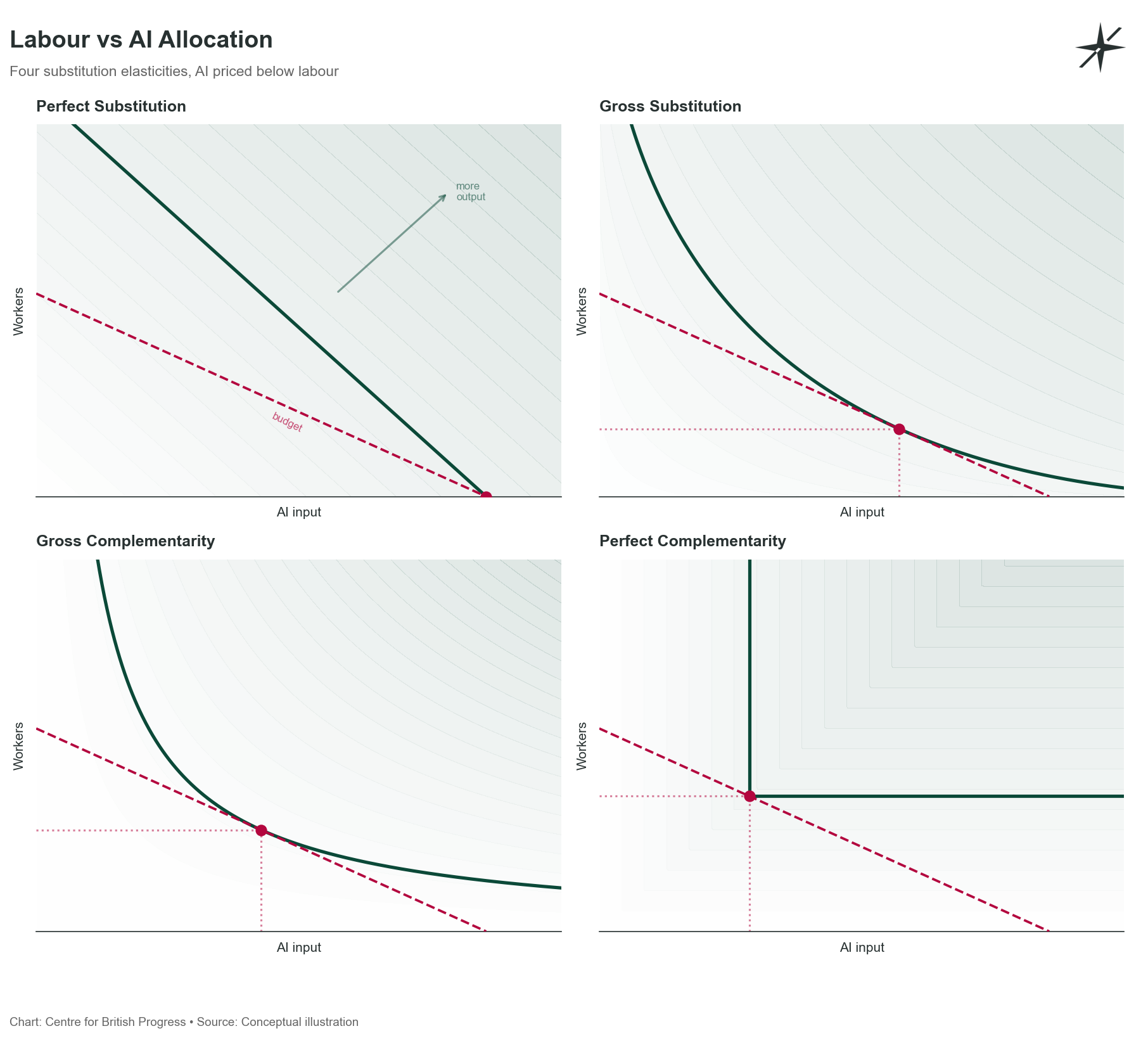
AI has not, however, advanced evenly across all tasks. If this uneven advance continues, human labour can still add value even when AI is cheaper at every task. The binding constraint becomes the opportunity cost of compute, rather than its absolute price. This is because it is better to devote finite compute to the things AI is extremely good at, and still use humans for remaining tasks. This is illustrated in the top-right quadrant, a gross – or imperfect – substitution scenario where the firm’s choice of inputs demonstrates comparative advantage at work.
The two top scenarios differ sharply: in the top-left scenario, wages and employment fall to zero, while in the top-right scenario, workers still have jobs and wages. In both instances, the labour share of output falls, because AI expands output faster than human contribution. (Note that this is only the labour share of output; if overall output rises sufficiently, overall employment may not fall).
The bottom quadrants describe complementarity scenarios, where workers and AI increase each others’ output. In these scenarios, human labour is the binding constraint, so wages keep pace with output growth, and labour’s share of output may even rise.
These bottom scenarios are likely to be better for workers overall, but they do not necessarily translate into better outcomes for everyone.
A gross-complementarity world with growing wages can still produce extreme inequality through so-called superstar effects, in which only the top performers benefit from higher pay. Inequality could also increase through high-human-capital individuals earning increasingly through capital rather than wages. The question of whether technological progress and economic growth is compatible with a (potentially growing) permanent underclass may well be entirely separate from whether or not AI completely eliminates all demand for labour.
When it comes to drivers of demand for labour, the literature has so far neglected the question of how AI may change the structure of firms. Most human labour is not summoned on demand through an app, with worker-contractors materialising to perform tasks. Workers are embedded in firms, which bundle some work and purchase the rest. So far, discussion of how AI hits work has provided sophisticated frameworks for substitution at the task and job levels, but has said comparatively little on firms.
Why the factory superseded the weaver’s cottage
The putting-out system in early industrial England had something of the flavour of this heavily individualised market-based system: merchants handed raw wool to weavers and spinners in their own cottages, paid them by the piece, and collected the cloth a few weeks later.
It was an economy made up of many different independent producers coordinating through markets and prices. Over several decades, it gave way to the factory system, to some degree because the market relationship struggled to handle the parts of production that were harder to put in contracts or negotiate.


A merchant could specify a price per yard and a weight of wool, but not how to set the new water frame, judge the fibre, or train a hand. The factory absorbed those tasks by putting workers, tools, and supervisors under one roof, where what could not be written into a contract could be passed by example and accumulated as firm-specific capital.
Centuries of similar discovery, in retailing, farming, finance, and software, have built the structures which the AI-and-labour literature has implicitly treated as background scenery. They are the accumulated answer to a problem that does not go away when AI gets cheaper and more capable.
A missing theory of the firm
If tasks and jobs are substitutable enough that any input can perform them, the existing distribution of firms is puzzling: the same kind of work can often be produced by single contractors (such as a freelancing accountant or lawyer) or by multinationals with hundreds of thousands of employees1. The tasks are the same, but the organising structures are vastly different.
This leads us to ask what industrial structures might look like in a world of highly capable AI and complete substitution. If demand for labour disappears, what happens to companies and sectors? A few giant companies with one owner each? Millions of one-person firms? Or networks of automated systems trading with each other, with humans nowhere in the loop?
A world without labour demand is one in which the only thing humans have to do is tell AIs what to do, and firms themselves are reduced to bundles of capital and AI, owned by humans but employing none.
One might object that the two questions are separable, that firms will continue to exist much as they do regardless of what happens to wage labour. They are not separable. A firm without workers is a different kind of entity: its boundary, its purpose, and the way it coordinates production all have to be redefined. Waged labour disappears only if AI can solve the problems that forced firms to employ workers, rather than contract with them at arm’s length or share ownership with them, in the first instance.
Let’s talk about bundles
Tasks bundle into jobs because doing tasks together makes each of them more productive than doing them separately. Whether AI causes displacement depends on whether that complementarity is stronger than the automation of any individual task.
There are at least four different mechanisms that explain why those bundles might stay together even when AI makes each individual task stronger. Let’s take a whistle-stop tour through some of the economic literature.
The first is coordination costs. When the cost of splitting a job’s tasks across separate actors (one of which may now be an AI) is low, the bundle is weak and AI can take over a task without much loss of overall efficiency. When that cost is high, the tasks hold together even when AI is better at one of them. The canonical example is radiology: AI may outperform radiologists at image classification, but the task sits inside a bundle alongside patient communication, clinical judgement, and training, and pulling it out costs more than keeping the role intact.
The second is quality complementarities. Some production processes are like a chain: output depends on the product, not the sum, of task quality, so a sharp drop in performance in one task badly drags down the value of the final output. In this framing, automating one task concentrates the worker’s time on what remains, raising its value rather than reducing it.
The third is the level of expertise of the task being removed. This matters as much as how many tasks are automated: removing inexpert tasks raises wages and shrinks employment, while removing expert ones has the opposite effect. The same gross level of automation can produce very different distributional outcomes depending on what kind of work is being replaced.
The fourth is within-job learning. Performing one task makes the worker better at the next, so separating tasks across agents destroys the build-up of skill that compounds inside the role. Automation still happens once all the tasks can be performed more cheaply by AI, but these mechanisms help explain why that point might come slowly, or never at all.
Bundles of bundles
Each of these mechanisms describes why markets cannot solve the problem of every single task one at a time. Productive activity cannot be broken apart into thousands of little tasks and reallocated efficiently without losing the complementarities, learning, and coordination that make them productive. That is why jobs exist.
Coordination costs, learning across tasks, quality complementarities, expertise asymmetries: they all explain why we have jobs at all.
More broadly, economic frictions are the reason the economy is organised around firms instead of relying on markets in everything. Contracts cannot specify every contingency. Neither workers nor firms can know in advance what a productive relationship will look like. Monitoring is costly, both for firms and for workers. Some production knowledge is tacit. Search for new workers or suppliers is slow. Long-term investments force people and companies to work together for a long-time. Coordinating solutions to all of these problems cannot be done simply by hiring a service every time a decision is needed.

Firms, employment contracts, career ladders, supplier relationships, and professional hierarchies are answers to these problems. Employment itself is one such solution: a wage is a fixed payment, not a share of the output or a place at the decision table, offered in exchange for a worker’s willingness to be directed on problems that cannot be fully specified in advance.
The employer takes on the risk of uncertain output and the responsibility for making decisions, and in exchange gets to decide what the worker does. That swap is central to how firms differ from markets: it marks places where coordinating through instruction is cheaper than coordinating through prices or negotiation. This is a rational arrangement. It isn’t possible to write a perfect contract covering every conceivable situation, so firms hire people and pay them wages instead.
This should make us re-think the scope of claims that AI will take everyone’s jobs. Performing tasks more cheaply than humans is not enough to eliminate labour demand entirely.
Instead, AI would have to make the wage mechanism itself obsolete, by removing the economic reason to hire anyone when the work cannot be fully described in advance.
Ah, you may say, but couldn’t the superhuman AI just write those perfect contacts which account for every possible contingency?
Yet the challenge of writing them is not the only reason contracts are often incomplete. The real challenge is that some information is unknown. A worker knows their own effort, intent, and judgement; the firm does not. And neither does the blazing fast intelligence working on the company’s behalf.
The reverse is also true: workers cannot fully verify how well the firm is doing, what its plans are, or whether the promises it makes today will hold tomorrow. Each side has to take some things on trust, because not everything can be written into the supply contract.
The wage relationship rests on that trust: the worker accepts a fixed payment and the firm’s right to direct her; the firm absorbs the risk of uncertain output and the responsibility for decisions; and both bet that the other will hold up over time. A faster, more intelligent counterpart on either side does not change this. Trust is a belief about how others will act in the future, and being smarter does not automatically generate it.
More than the boundary of the job, the boundary of the firm matters. If AI dissolves the frictions that sustain employment, economic activity should become easier to govern through contracts and arm’s-length exchange. If instead it creates new firm-specific knowledge, new returns to internal learning, new monitoring problems, or new reasons to hold decisions inside the firm, then it is rearranging those frictions rather than dissolving them.
Changing bundles
The evidence so far suggests AI is more likely to push work inside firms than outside them. Three mechanisms point that way.
The first is that decisions stay where the information is. The more decisions AI handles inside a production process, the more valuable it becomes to keep them under unified control rather than splitting the returns with a contractor. The same logic at scale can give rise to “superstar firms”: once AI can replace problem-solvers and not just routine workers, firms can grow dramatically with minimal human supervision, while still wanting that activity to happen inside their boundary.
The second is the diffusion of on-site learning. Firms with multiple facilities can extract more value from AI because learning spreads across sites within the same firm in a way it does not across arm’s-length contracts.
The third is a recent finding that can be easily missed. Worker behaviour itself is a kind of capital that can be used to train AI, but it only accumulates where work happens under observation. But workers push back: telling them their data will be used to train AI makes them hide their knowledge more. The implication cuts against the full-displacement story: as long as any labour demand remains, more of that work is likely to be done by employees inside firms, not by contractors trading at arm’s length.
There are forces pushing the other way. Better prediction (a presumed feature of AI) can make written contracts more complete, weakening the case for keeping activity inside the firm. This matters where the information is shared. It does not where information is private, which is exactly where the wage mechanism remains the more useful arrangement.
On balance, this work suggests AI may reinforce the role of firms even if the average firm shrinks across the distribution. The economic motive to internalise production keeps people inside firms as workers rather than as contractors with AI on the outside, whatever the eventual form of compensation.
Unbundling institutions
Economists tend to work with broad aggregates that are crude representations of reality. The idea is that these models, while simplified, help to isolate mechanisms and build good intuitions. Reasoning from them is fine, when the structure they disregard is not what the question is about. But it is not fine here. The reasons for why tasks bundle into jobs, and jobs into firms, are the kind of deep economic mechanisms that should not be sidestepped when reasoning from broad aggregates.
The actual economy is not organised that way. Tasks bundle into jobs because performing one task well requires having a skill that lets workers perform associated tasks well; what workers learn performing one task makes them better at other tasks, and removing some tasks from jobs can make the cost of coordinating them prohibitive.
Jobs coalesce into firms because contracts cannot specify every possible outcome, because learning across different sites requires unified ownership and strong knowledge transfer processes, and because decision-making and judgement have to be governed somehow. These structures evolve to capture value that would not exist in a world with only markets and haggling. Predicting the elimination of all wage labour without working out what firms would become if that happened is to misunderstand why they exist in the first place.
The displacement of labour is really a claim about redesigning all of economic activity, not just substituting humans when performing tasks. To do that, AI would have to dissolve the frictions that gave rise to the institutional architecture of the modern economy: incomplete contracts, private information, tacit knowledge, asset-specific investment.
If AI can dissolve those frictions, the consequences could be as transformative as AI’s most ardent prophets predict. The labour share could fall and the wage mechanism become redundant, with economic activity reorganising around AI capital. Reaching that destination, though, would mean rebuilding the institutional architecture of the economy, and that kind of transformation is historically slow.
Electrification was gradually happening for forty years before its productivity gains showed up, because factories had to be redesigned around it. The factory system itself took half a century to displace the cottage production of those early weavers.
A transformative displacement story rests on a load-bearing assumption that is rarely made explicit: that AI can solve all the problems that produced the institutional architecture of modern economic activity in the first place. Yet centuries of accumulated practice, contract, and tacit knowledge do not unwind at the speed of a model release.
Consultancy is a useful reference point: both individual contractors and large multinationals operate at scale in the same industry, and sometimes compete for the same contracts.
 | A guest post by
|