

Hot Progress Summer: A reading list
Book recommendations to spark big ideas


As schools prepare for summer holidays and Parliament readies for recess, there’s a rare opportunity to take stock. Although it might be a busy break for many, there’s always time to pick up a good book that might just transform your thinking.
Forget the Sunday Times list or the latest Booktok sensation – this summer’s hottest reads come courtesy of people who spend much of their time figuring out what progress looks like. We asked an eclectic mix of doers and thinkers for their suggestions.
Making sense of the present
Recent releases that break down the big issues of our time
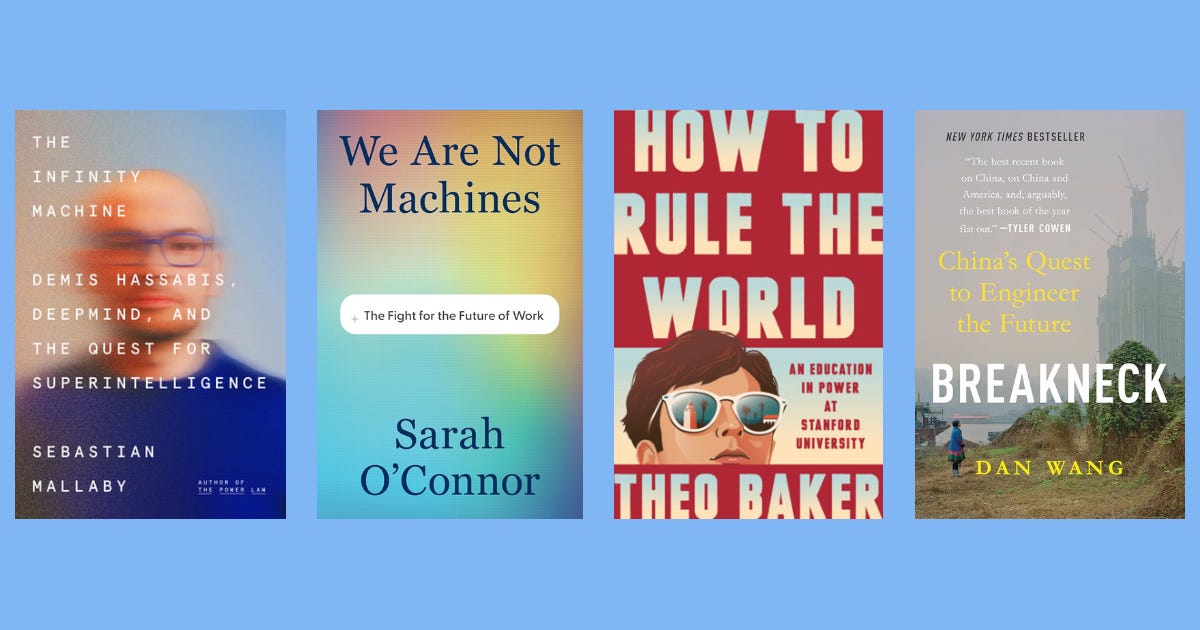
The Infinity Machine: Demis Hassabis, DeepMind, and the Quest for Superintelligence, by Sebastian Mallaby
“AI is the central driver of our prosperity, and DeepMind a core anchor of it in the UK. Understanding why it is here, what we have lost of it, and what we should do in the future is critical to our national destiny.”
— Kanishka Narayan, MP for the Vale of Glamorgan and Minister for AI and Online Safety
How to Rule the World: An Education in Power at Stanford University, by Theo Baker
“I couldn’t put this down. Baker, a recent Stanford graduate, writes about his time at the student newspaper and his first-year investigative journalism that took down the university president. But beyond that story, the book is also a sharp window into Stanford’s relationship with Silicon Valley money. As Steve Blank, a serial entrepreneur who teaches a startup course there, tells him: “Stanford is an incubator with dorms”. Even if you don’t feel the need to see the book as a deeper meditation on power and money, it’s a thoroughly entertaining read.”
— Jonathan Lenson, CEO of Milltown Partners
Breakneck: China’s Quest to Engineer the Future, by Dan Wang
“Dan Wang’s inside look at contemporary China and the strengths and weaknesses of their system is superb. Fun to read, but terrifying for European readers to see how far behind we are.”
— Neil O'Brien, MP for Harborough, Oadby and Wigston and Shadow Minister for Policy
We Are Not Machines, by Sarah O’Connor
“It’s by one of the FT’s best writers and columnists covering AI and the world of work. It’s well-reported and it will surprise you, whatever priors you went into it with!”
– Yuan Yang, MP for Earley and Woodley
Lessons from history
Historical accounts, both factual and fictional, that can teach us something important for today
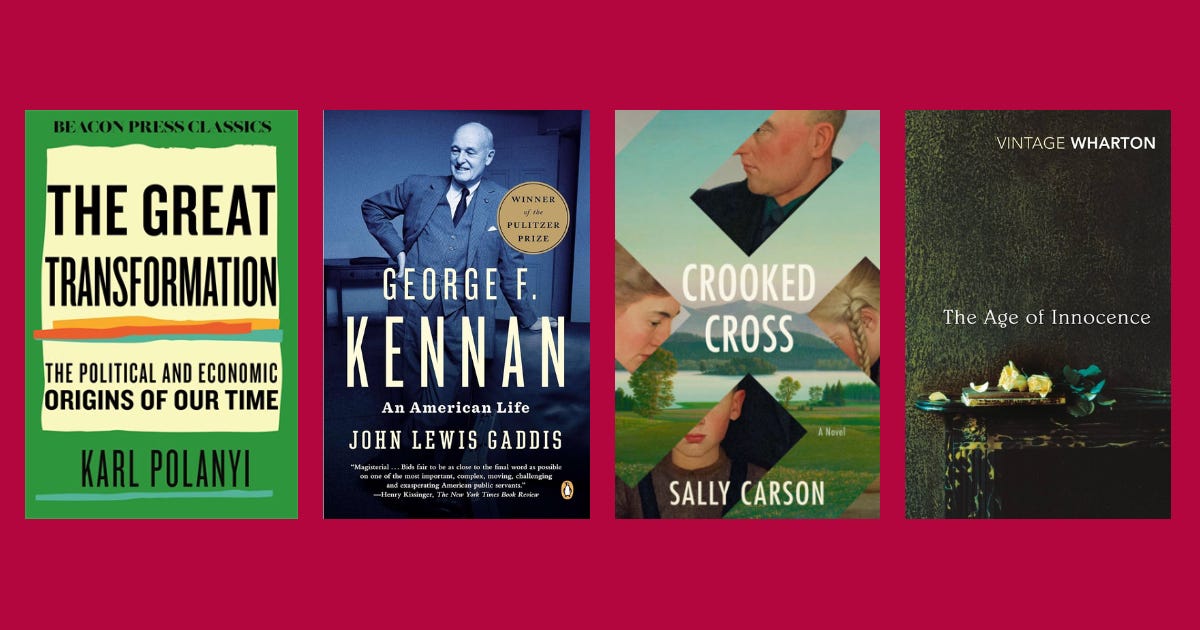
The Great Transformation, by Karl Polanyi
“A new technology threatens to upend our understanding of fundamental categories of labour and capital; thinkers and writers wrestle with the implications; and policy entrepreneurs design ambitious new institutions - including guaranteed incomes - to deal with the fallout. Not AI in 2026, but machine-powered manufacturing in the early 19th century. Karl Polanyi’s classic treatment of how society responds to radical technological change is essential reading (and a cautionary tale) as we confront a new – and perhaps even greater – transformation.”
– Matt Clifford, Co-founder of Entrepreneurs First and Chair of ARIA
George F. Kennan: An American Life, by John Lewis Gaddis
“Kennan did more than almost anyone to define American foreign policy towards the Soviet Union in the late twentieth century through his doctrine of containment. We reach too easily for the word ‘unprecedented’ about a world that, in many ways, now looks more like Kennan’s than it did during the brief holiday from history of the 1990s and 2000s. It is not a short book, so for a sharp summary of Kennan’s character and significance I’d also recommend Henry Kissinger’s essay, ‘The Age of Kennan’.”
– Kane Emerson, Head of Communications at the Centre for British Progress
Crooked Cross, by Sally Carson
“This book will transport you to the world of pre WW2 Germany and the life of a very ordinary, non-political family living in a small town. As their country starts to change with the rise of the Nazi party, their family and friends are enmeshed in a frightening drama. Incredibly relatable to our world today where identity politics and ideologies can become all consuming and impede human relationships.”
– Baroness Rachel Maclean
The Age of Innocence, by Edith Wharton
“Wharton wrote the novel in the aftermath of WWI, during the unravelling of the interwar years. The old, rigid, proper New York society of her childhood and the transformed world she was writing in were barely recognisable as the same civilisation. We probably underestimate how destabilising that would have been. Flying metal beasts, pictures that moved and talked, worldwide geopolitical competition – these changes pressed up against the quotidian decisions one made (like what to wear, how to raise children, who to marry). What does it feel like to have made personal choices fit for a bygone age and then see the world move past and overtake those choices? I’m not sure how the revolutions of our time (primarily AI) will change the lives we live, but we should know that the decisions we make will ripen in a very different world. Archer, on that bench, might be the best encapsulation of that fear.”
– Julia Willemyns, Co-founder of the Centre for British Progress
The American Challenge, by Jean-Jacques Servan-Schreiber
“A 1967 bestseller warning Europe was becoming America’s technological colony. The author’s cure was radical openness plus a state-led plan to build champions. Europe kept the planning instinct, dropped the openness, and pointed the planning at regulation instead.”
– Brendan McCord, Founder of the Cosmos Institute
Big ideas
Books to make you reflect on how things happen, and how we would like them to be
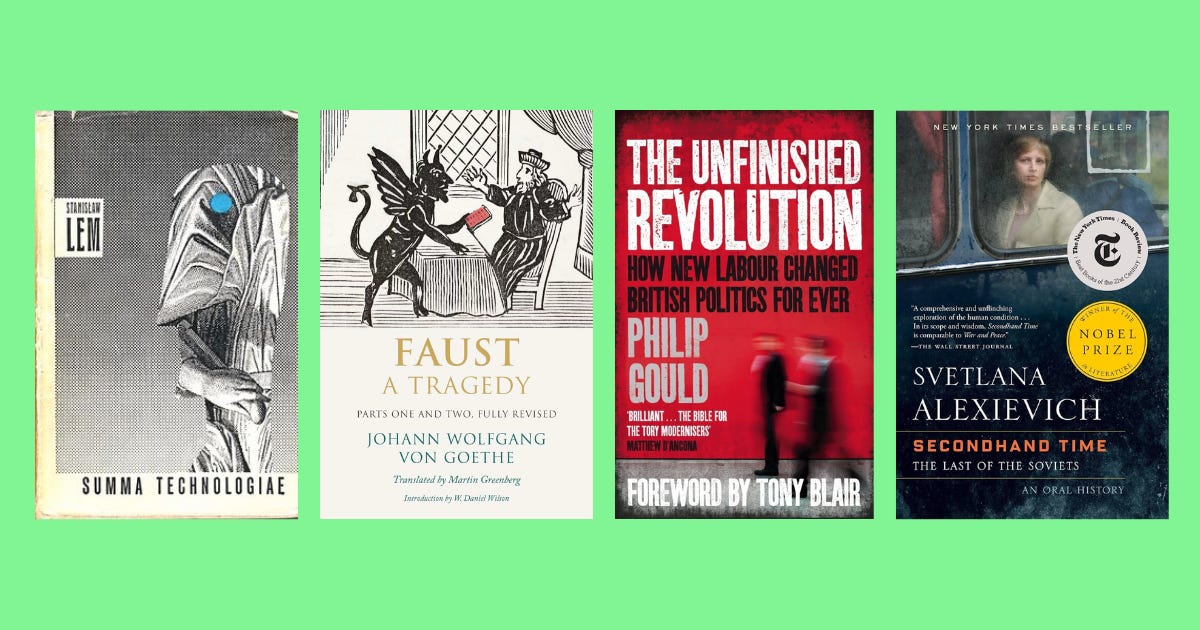
The Unfinished Revolution, by Philip Gould
“Don’t just focus on understanding the economy. To win and have our ideas take root we need to be political – and there’s not many books better at explaining how a political project rooted in the hopes and aspirations of the British people can be built.”
– Dan Tomlinson, MP for Chipping Barnet and Exchequer Secretary to the Treasury
The Rise and Fall of the Neoliberal Order, by Gary Gerstle
“It’s fashionable to talk about what a “turning point” we, in Britain, and the West more broadly find ourselves at. But, in this moment, we would do well to look at how we got here. This book looks at the role of free markets in reshaping how we live and interact with the world and, by extension, one another. But, this is not just another critique of ‘neoliberalism’ which mindlessly argues that free markets are inherently bad. It is a thorough and rigorous review of one particularly economic ideology which assesses the potential dangers that lie ahead.”
— Victoria Spratt, Housing and Society Correspondent at The i Paper
Second-Hand Time, by Svetlana Alexievich
“An obsession with economic growth can feel like a narrow and myopic concern with material wealth, one that disregards everything that makes human flourishing an important mission. This book is a helpful reminder that the opposite is true. GDP understates the improvements in wellbeing that growth delivers: measured through the value people place on their own remaining years, living standards across the world have risen five to seven times since 1940, against a mere doubling in the official figures. Alexievich’s interviews interrogating the cultural and social fallout of the failure of Soviet communism are a sobering warning of what happens when we fail in that mission. What haunts the book is her demonstration that prolonged stagnation breeds a self-reinforcing culture of meanness, where repressed material want makes people callous and grasping, yet nostalgic for the very system that deprived them. A society where growth is the default is one where material comfort recedes into the background, and people are freed to be less materially obsessed and spend their time on the things that make life worthwhile.”
– Pedro Serôdio, Chief Economist at the Centre for British Progress
Summa Technologiae, by Stanislaw Lem
“From the Poland of 1964, but still one of the sources for pondering the philosophical issues surrounding advanced artificial intelligence.”
– Tyler Cowen, Chairman of the Mercatus Center
Faust, by Johann Wolfgang Von Goethe
“Westminster’s obsession with Machiavelli’s The Prince is detrimental to their mental and moral well-being. Goethe is a superior teacher for politicians. His two most important lessons were that solipsism is the greatest sin and that constant striving for betterment is our only redemption. Dip in and out of it; it’s not an easy read, but, ask yourself, why should it be?”
- Stella Tsantekidou, Columnist and broadcaster
Around the world and in other realms
Books to transport you to other places – even if some of them bear an uncanny resemblance to the worlds we already know
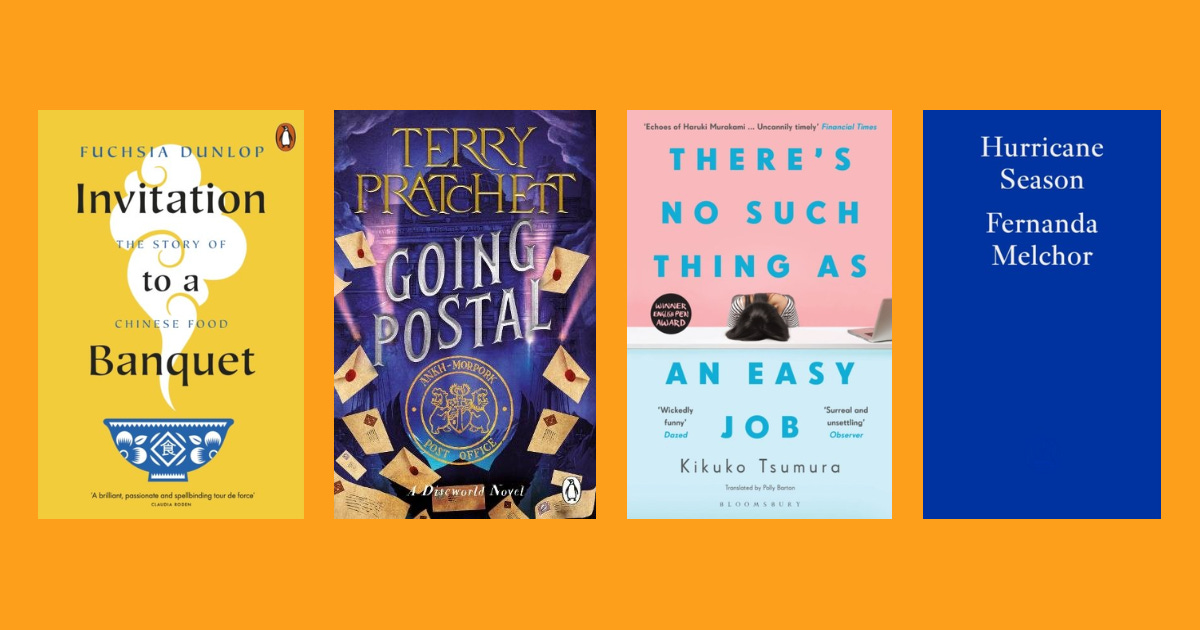
Invitation to a Banquet, by Fuchsia Dunlop
“People don’t believe me when I tell them that my 2 year old’s favourite food is cabbage. It’s true, but the reason is because he eats the most delicious cabbage in the world, cooked by his Nai Nai (my mother), in a traditional Chinese way. The cabbage is sautéed in garlic and chilli, but not overdone, to retain its crunch. The key final ingredient is Chinkiang vinegar. Chinese food is some of the most loved but least understood food in the world, and Fuchsia Dunlop is the perfect guide. Unlike most recipe books, Invitation to a Banquet also includes history and storytelling. Unlike most history books, it’s about the best food in the world.”
– David Lawrence, Co-founder of the Centre for British Progress
Going Postal, by Terry Pratchett
“A brilliant, and very funny, study in the absurdity of bureaucratic institutions. I can think of no better guide to the inner workings of the British state!”
– Katie Lam, MP for Weald of Kent and Opposition Assistant Whip
There’s No Such Thing as an Easy Job, by Kikuko Tsumura
“If you’re the kind of person who struggles to take a break from work over the summer, you will probably relate to this funny, surreal narrative about a woman’s quest for a burnout-free job in an unnamed Japanese city. Her tasks range from writing fun facts for snack packaging to looking after an urban forest, but at each turn, something unnerving or unusual happens. Tsumura is excellent at capturing the small calamities of the workday and sending them up in absurd fashion.”
– Alys Key, Editor at the Centre for British Progress and Creator of UK 2.0
Hurricane Season, by Fernanda Melchor
“If watching Mexico face England in the World Cup inspired you to delve deeper into Mexican culture, I’d recommend this novel. Not for the faint-hearted, but a thought-provoking (and unusually written) portrait of love, lust, violence and poverty set in rural Veracruz.”
– Matthew Grant, Policy Fellow at the Centre for British Progress